 |
KRISHI VIGYAN KENDRA DIMAPUR ICAR RESEARCH COMPLEX FOR NEH REGION NAGALAND CENTRE, JHARNAPANI MEDZIPHEMA-797 106, NAGALAND |
|
|
|
|
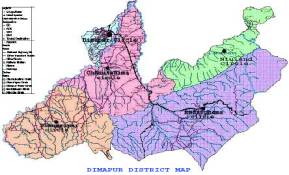
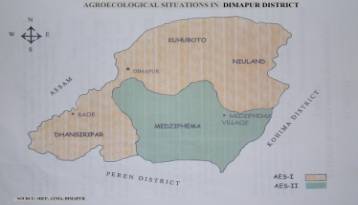
About Dimapur District: 1. IntroductionDimapur is the 8th district of Nagaland established in December 1997 and lies between 25048’ and 26000’North latitude and 93030’ and 93054’ East longitude.The district is bounded by Assam on its North and West, Kohima on the East and Peren District in the South. The district comprises of four blocks and 11 agricultural circles with an area of 927 Square kilometers. Medziphema block has a total area 345 sq. Km. with 67 revenue villages. Likewise, Dhansiripar block is spread over 130 sq.Km area with 28 revenue villages, Nieuland block has a total area 305 sq. Km approximately 59 revenue villages whereas Kuhuboto block has a total area of 147 sq. Km.with 38 revenue villages. Of the four blocks Niuland sub-division is managed by an Additional Deputy Commissioner and rest of blocks are manned by SDO (Civil).
2.1 Historical genesis of the district:
The district has a heterogeneous population with majority comprising of Naga tribes from all over the Nagaland. There is sizable population of non-tribal living in the town areas. Although notified town of Dimapur district has remained the same, the neighboring villages /settlement have expanded considerably over the years merging with town boundery to form a length of more than 13 kms. In addition, there is sizeable rural population in the Sub-division of Niuland, Kuhuboto, Dhansiripar and Medziphema blocks. The total population of the district as per 2001 census is 3, 08,382. The main factor contributing to large increase in population of the district is migration from other parts of state. There is also considerable migration from Assam.
Dimapur city, the major commercial hub in Nagaland, has a
heterogeneous mix of people from all over India, and for which it is
also known as "mini India." Besides the dominant Naga tribes
who comprises about 50% of the city's population, other prominent groups
include Bengalis, Assamese, Nepalese, Biharis, Marwaris, Punjabis and
also Tamils and Keralites. In the last two decades, Tibetan traders have
also settled in the city. In Dhansiripahar sub division, the tribes inhabiting the area is predominantly Angami, Sumi, Kachari and Chakhesang while in Medziphema sub division, the Angami tribe is predominant although a few Kuki and Sumi villages are also found. In Kuhuboto and Niuland sub divisions, the Sumis are the predominant tribe inhabiting the areas. All these tribes have their own customary laws which dominate their social life. The Village Councils are the local bodies through which such customary laws are enacted. The norms and traditions regarding marriage, divorce, inheritance, death etc are governed by such customary laws. Disputes regarding land, water and such resources and even personal disputes are very often resolved based on these customary laws.
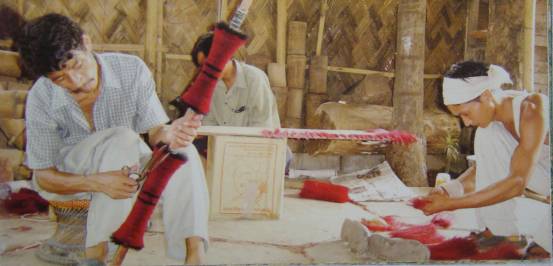
Fig: Diezephe-The craft village of the district In Dimapur district, all these tribes also celebrate their own indigenous cultural festivals. The following is a brief write up on the festivals of the major tribes that inhabit the district. The Angami tribe celebrates Sekrenyi in the month of February. It normally falls on the 25th day of the Angami month of Kezei. The ten-day festival is also called Phousanyi by the Angami's. The festivals follows a circle of ritual and ceremony, the first being “Kizie” followed by “Dsuseva” (touching the sleeping water) sacrifices are also made during this time. Ahuna is a traditional post harvest festival of the Sumi tribe. Ahuna signifies the celebration of the seasons harvest's in thanks giving, while evoking the spirits for good fortune in the New Year Tuluni is a festival of great significance. The festival is marked with feast as the occasion occurs in the bountiful season of the year. It may be mentioned that other tribes who have settled in Dimapur also celebrate their festivals with as much pomp and gaiety. The Ao tribe observes Moatsü Mong after the sowing is done. It provides the Aos a period of recreation after the strenuous job. The festival marked by vigorous songs and dances merry making and fun is now observed only for three days from 1-3 May. The Aos have another festival called Tsungrem Mong celebrated on the eve of harvest from 1 to 3 August. These festivals provide opportunities to the building generation and village stalwart to demonstrate their intellectual skill and physical powers. The Tokhu Emong is the harvest festival of the Lothas. Tokhu Emong is celebrated on November 7, every year. The main features of the feast are community songs, dances, feast fun and frolic. Tokhu Emong is also a festival of thanksgiving, sharing and reconciliation but the most beautiful aspect of this festival is that past rancor's are forgiven, new ties are formed and bonds of closer intimacy are formed. The Chakhesang community celebrate the Suhkruhnye festival on15th January which is their most important festival. All the tribes celebrate their distinct seasonal festivals with much gaiety and community feasting. Most of these festivals revolve round agriculture, since it is the main-stay of Naga society. Over 85% population of Nagaland is directly dependent on agriculture and lives in a thousand and odd villages situated on high hill tops or slopes overlooking verdant valleys humming with murmuring streams.
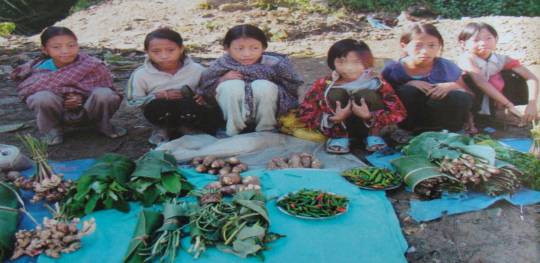
Fig: Friday local market at Medziphema
3.
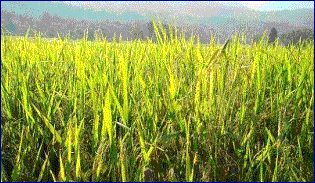
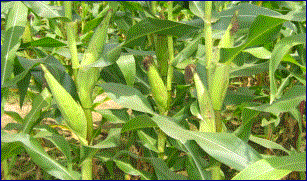
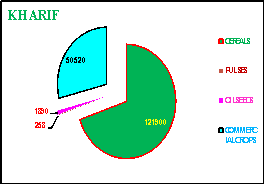
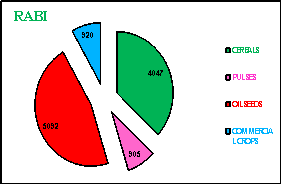
Agriculture in Dimapur district The agriculture in the district is TRC, rainfed and tradional. By and large mono cropping is practiced in the district. The TRC paddy alone covers an area of 32,900 ha where as Jhum covers about 7,800 ha. Besides the second important crop in the district is Kharif, Maize covers about 2500ha. Maize is generally grown as a inter crop with jhum paddy. Winter maize is also grown in certain blocks of the district which covers about 460 ha.
Fig: With the favourable agro climatic condition, oilseeds such as groundnut, soybean, sesame, sunflower, mustard, linseed, etc. are grown in an area of 5800 ha. Commercially viable crops such as sugarcane, ginger, jute, turmeric, tea, potato etc are also grown in the district covering an area of 1,580 ha. Mechanized farming is encouraged, by providing 50% subsidy on power-tillers.
Table
3. Agricultural statistics
Crops, Area, Production and Productivity
Source: Statistical handbook of Nagaland 2007
Fig: Source: DAO, Dimapur
4.
Horticulture of Dimapur district In Nagaland, fruits and vegetables are produced in 25000 and
26300 ha with the total production of 25600-32000 tonnes, respectively
of which Dimapur district contributes major portion of production.
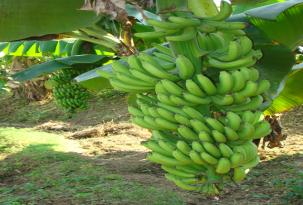
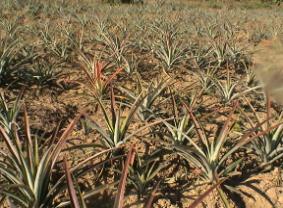
Commercial cultivation of pineapple, banana, cashew nut and lemon is
also followed in the district.The Horticulture Technology Mission (HTM)
has helped to a great extent in popularizing the cultivation of
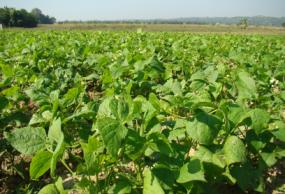
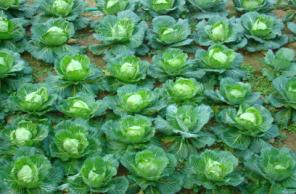
horticultural crops including floriculture. 4.1 Horticulture Potential: The state of Nagaland in general and Dimapur in particular has been gifted with a unique topography and varied agro – climatic and soil conditions, which offers opportunities to cultivate a variety of horticultural crops like vegetables and fruits. Among vegetables spring summer ( cucurbits, bhindi beans), summer (cucurbits, bhindi, beans) as well as winter vegetables( cabbage, cauliflowers, carrot, radish, palak, pea,etc.) are being cultivated in the districts. Fruits like pineapple, guava, lemon, litchi, and mango are the major ones covering the area in district. Among floriculture, the commercial crop is Anthurium.
Table 4. Area,
Production and Productivity of Horticultural crops;
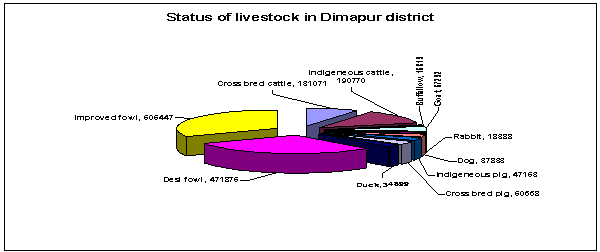
5. Animal Husbandry in Dimapur Under our socio-economic and socio-cultural condition, the state needs job-led economic growth strategy based on pro-nature, pro-poor and pro-women policies of orientation and its dissemination. The role of livestock and poultry farming in livelihood earning of farmers is enormous. Dairy farming is being practiced by a number of farmers in the district. The milk is being collected by the Dimapur Milk Union Limited at 4th Mile Dimapur and is processed for the production of milk products like milk packets, curd and ghee etc. The dairy farming is mainly practiced by Nepalese and other state people. Pig and poultry is very common in the district. In rural areas of the district each and every household has 1-2 pigs and 5-6 nos. of poultry birds in the backyard of house. After poultry, duck is being reared in the district. Goat and rabbit is limited to small number only.
Source: Department of Veterinary and Animal Husbandry, Kohima Table 6. Carcass yield of meat animals
5.1 Cattle production system In the district most of the farmers leave their cattle for free grazing except during paddy cultivation period. However some farmers’ follow stall fed system. 5.2 Mithun production System The Mithuns are not reared in the district. But in Mezdiphema, block National Research Centre on Mithun was established in 1988. The 76 Mithuns of Nagaland, Manipur, Mizoram and Arunachal Strains are being maintained by NRC-M for experimental purposes.
5.3
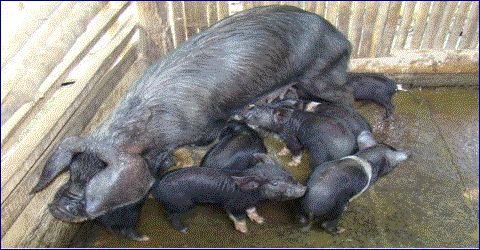
Goat production system For goat rearing free grazing system is followed. 5.4 Pig production system In pig production both loose and stall fed system is practiced. In piggery, most of the farmers follow stall fed system with kitchen waste and locally available feeds like Colocacia leaves and stem, rice polish, wheat bran etc. The Veterinary department is trying to provide the health services by organizing the veterinary camps and trainings. There animals are examined, vaccinated and medicines are provided as per need. (Photo-pig rearing)
5.5 Poultry production System Most of the farmers follow backyard system of poultry rearing, however, some farmers with higher number of poultry birds follows deep litter system. In case of backyard poultry system, the birds are fed with broken rice / maize seeds in morning and evening. The birds are more prone to diseases due to unhygienic conditions.
5.6
Constraints, Strategies, Technological intervention and Action plan
of different Livestock Production System
Strategies:
Technological intervention and action plan
6.
Fisheries in Dimapur district
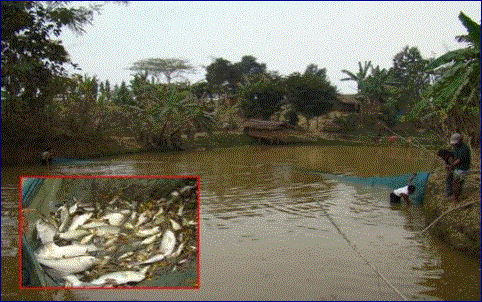
6.1 Introduction and potentials of fisheries Dimapur district has got good potential for fishery development in dams, rivers, ponds and small lakes, which is under progress in some areas like in Zuheshe Village under Niuland Sub Division, and a big fishery development project is also under progress near Seithekima- A village. The district has a lot of marshy land which can be developed into ponds and fish farming will raise economic status of the rural poor. Fishery department is assisting the rural poor by providing fingerlings under renovation scheme. Paddy cum fish culture is being practiced in the valley or low lying areas of the district. The department of fisheries has constructed the dams in Chathe river to improved the condition of fish farming in the district.
6.2. Current area under Fisheries production and productivity Though the district has the potential for development of fisheries, the total area of the fish farming is only 1170.81 hectares (source – Dept. of Fisheries, Govt. of Nagaland). The production statistics for the district is not available. KVK Dimapur is in the process of building a data base on fisheries by 2010. Under Renovation scheme Fingerlings were distributed by the department of fisheries, Govt. of Nagaland, during 2004 -05 for Dimapur district. Table No. 8
Source: Statistical handbook of Nagaland 2007 7. Sericulture in Dimapur district The entire district of Dimapur is unique in large Bio- Diversity of Sericigenous Flora and Fauna, Climatic and Soil conditions prevailing in the Entire District of Dimapur is also suitable for Commercial Exploitation of all four varieties of Silkworms Viz- Mulberry, Eri, Muga and Tsar. Among these four verities of Silk activities, Eri culture and Muga culture have gained popularity in the District. 7.1 Block wise area under cultivation in silkworm food plants and productivity of silk During the year 2008 the production of disease free laying , cocoons and silk of Dimapur District Block-wise till date is:- Table 9. Mulberry Area in acres.
Source:
Deputy Director, Sericulture , Dimapur
Table 10. Eri
Area in Acres.
Source:
Deputy Director, Sericulture , Dimapur
Table 11. Muga.
Area in Acre.
Source:
Deputy Director, Sericulture , Dimapur It is seen that of the four types of Silkworm Rearing(Mulberry,Muga,Eri and Tasar) practiced in Nagaland ,in Dimapur Districts only three types of silkworm rearing namely Mulberry, Eri and Muga are practiced by the Farmers ,of which, Eri and Muga silkworm rearing are most popular. However, it is found that lot of constraints are being faced by the Farmers in the field which is found to be un-organized. The following Gap/Constraints are identified.
To address the above gap in the field it is felt that the following interventions are felt necessary under the present project. Technological Intervention:
1 Introduction of high yielding varieties of muga food plants. 2 Introduction of perennial variety of castor and Kesseru plants in the farm level. 3 Popularization of latest package and practices of raising of systematic eri and muga food plants. 4 Effort to increase the production of quality silkworm eggs of muga and eri. 5 Impart necessary training and skill up gradation for the rural farmers, particularly women. 6 Provide technological support in the pre-cocoon process. Marketing Intervention:
Financial Intervention:
Social Intervention:
Source: Deputy director, Department of
Sericulture, Dimapur
8. Forestry in Dimapur district. Before the state of Nagaland was separated from Assam, Dimapur Forest division was under Dhansiri valley forest division of Assam till the constitution of Naga Hills, separated from Assam in the year 1958 alongwith Tuensang and Mon area (NEFA). There is no Forest division worth name in Naga Hills except few Forest Offices viz. Rangapahar Range with Beat Offices under range at Dimapur and Nichugard (Chumukedima). Dimapur forest division as Kohima forest division came into being headed by a Deputy conservator of Forest with headquarter at Dimapur alongwith the creation of a new unit called Naga Hills Tuensang Area (NHTA) in the year 1961. The then Kohima forest division covers the present district of Kohima , Peren, Mokokchung, Zunheboto, Wokha, and part of Tuensang, Mon, Longlen and Kipheri with its range and Beat Offices at Rangapahar , Kohima, Nichgard (Chumukdema), Mokokchung and Naganimora for managing the reserved forests viz. Rangapahar R.F. , Singphan R.F. and Intanki R.F.
8.1. The forest type Under the district is mostly Northern Tropical Semi Evergreen forest (2B). Forest cover of the district as per 2005 SFR report as follows : 1. Dense forest – 140.00 sq km 2. Open forest – 266.00 sq km 3. Scrub forest – 6.00 sq km 4. Non forest – 4.00 sq km
Total
= 416.00 sq km
8.2. Legal status of
forest 1. Reserved forest – 62.26sq km 2. Purchased land – 8.1238 sq km 3. Zoological parks – 4.700 sq km
Total = 75.0838 sq km
Source: DFO, Dept of
Forest, Dimapur
8.3
Constraints, Strategy and Action plan
The division with a total dense forest cover of 140 sq km includes reserved forest for 62.66 sq km and purchased land for 8.1238 sq km. However, land encroachment is the major problem. Community Wildlife Sanctuary and Community Botanical Garden through people and community participation in conservation of the rich natural resource of the district is the alternative for the land encroachment. Financial assistance is provided to villagers for planting of forest tree saplings.
Source: DFO, Dept of
Forest, Dimapur
9.
Medicinal and Aromatic plants There are a lot of medicinal plants locally available in the district and are being used by the local doctors called Kaviraj. Many of these have not been identified and documented so there is urgent need of identification and documentation of these potential spps. Some of the species cultivated of large scale include, Tulsi (Green and Black both), Chiraita (King leaf), Aloevera etc. Citronella / lemon grass are also being promoted for cultivation in the district during 2001-02. 9.1 Area under different Medicinal and Aromatic plants
Area
under cultivation of aromatic and medicinal plants is 200 hectares and
production is about 300 MT (Statistical Handbook of Nagaland- 2007) 9.2. Constraints, Strategy and Action plan- Lack of awareness of indigenous medicinal plants. Identification and documentation of indigenous medicinal plants must be taken care of. The climate and soil conditions are very much suitable for cultivation of Lemon grass. During 2001-02 many farmers have started cultivation of Lemon grass but stopped after 2 -3 years due to lack of processing units. So development of processing unit for extraction of Oil and Oleoresins are necessary for the promotion of medicinal and aromatic plants in the district. Patchouli and Vanilla are being promoted by Department of Land Resources, Govt. of Nagaland, Dimapur for cultivation in the district but due to lack of marketing and processing units the farmers are being discouraged so development of market infrastructure and marketing channels and processing unit for extraction of Oil and Oleoresins need to be taken care of. | |||||||||||||||||||||||||||||||||||||||||||||||||||||||||||||||||||||||||||||||||||||||||||||||||||||||||||||||||||||||||||||||||||||||||||||||||||||||||||||||||||||||||||||||||||||||||||||||||||||||||||||||||||||||||||||||||||||||||||||||||||||||||||||||||||||||||||||||||||||||||||||||||||||||||||||||||||||||||||||||||||||||||||||||||||||||||||||||||||||||||||||||||||||||||||||||||||||||||||||||||||||||||||||||||||||||||||||||||||||||||||||||||||||||||||||||||||||||||||||||||||||||||||||||||||||||||||||||||||||||||||||||||||||||||||||||||||||||||||||||||||||||||||||||||||||||||||||||||||||||||||||||||||||||||||||||||||||||||||||||||
|
Site developed and maintained by: KVK Dimapur, ICAR Research Complex, Jharnapani, Nagaland.
This page was last modified on: 20-Jun-2010 |